
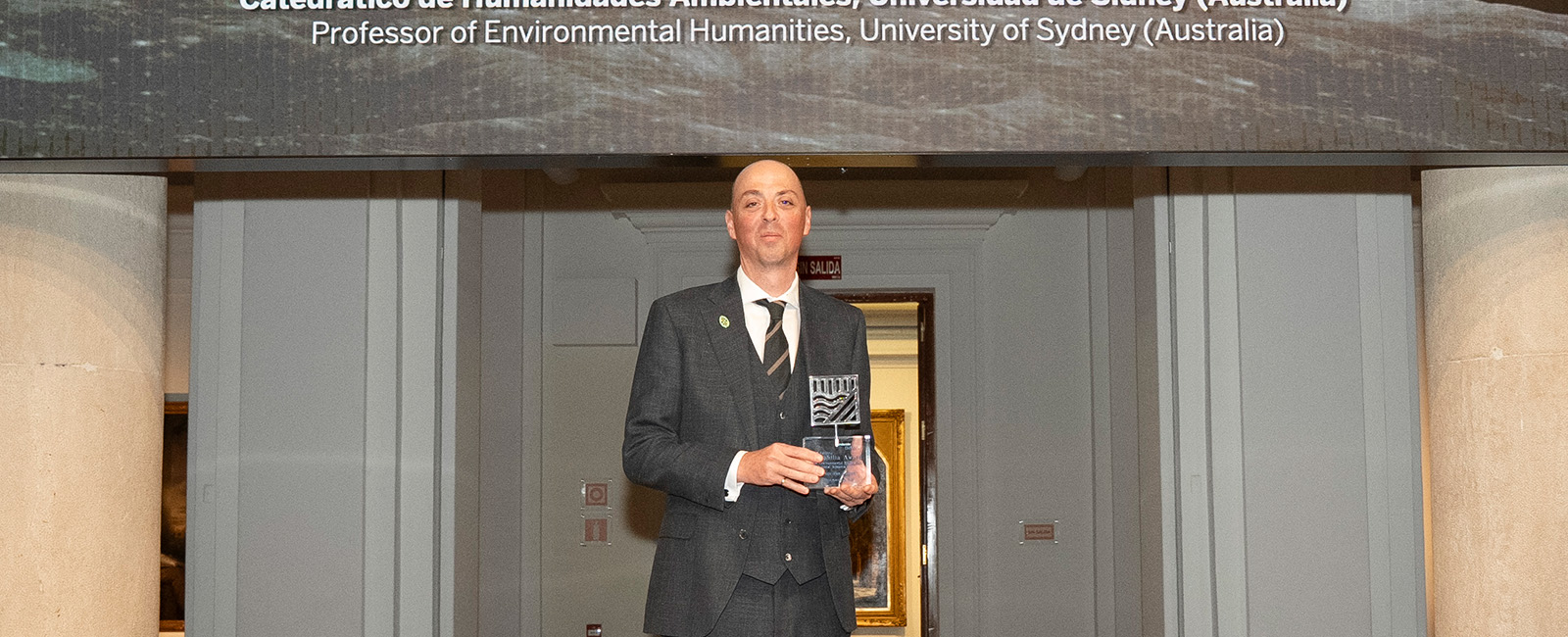
Thom van Dooren advocates a “multispecies ethics” to address the biodiversity crisis from the perspective of the environmental humanities during his Biophilia Award lecture
Thom van Dooren spoke of the power of the environmental humanities to articulate a “multispecies ethics” that gives moral consideration to “all living beings with whom we share the planet,” in his talk at the presentation ceremony of the 7th Biophilia Award. The professor at the University of Sydney (Australia) received the BBVA Foundation award for his “central role” in “shaping understandings of species extinction” and providing “a philosophical and ethical reframing of humanity’s relationship with nature,” in the words of the selection committee. After collecting the award at a ceremony held in the Palacio del Marqués de Salamanca – Madrid headquarters of the BBVA Foundation – Van Dooren delivered a lecture titled “Philosophy of Extinction” where he explained how the environmental humanities can contribute to identifying, communicating, and addressing more effectively the ethical obligations that arise from the global biodiversity crisis.
6 February, 2026
The awardee began with a reflection on the nature of his work: “I think of it as a kind of field philosophy that draws on knowledge from the humanities and natural sciences, as well as insights from ethnographic research with local communities, to understand what extinction means, why it matters, and what responses it demands.”
“Thom van Dooren has made an outstanding contribution to the environmental humanities, in both the academic sphere and for the general public, through fascinating, revealing stories that merge – or, to use one of his favourite words, “entangle” – human and non-human life, showing us not only what we are losing but what we may still have time to save,” said committee member Richard Kerridge, Coordinator of Graduate Studies and Research Management in the School of Writing, Publishing and the Humanities at Bath Spa University, in his opening encomium to the awardee.
The BBVA Foundation Biophilia Award, funded with 100,000 euros, distinguishes the contributions of professionals and organizations in any country that help reframe humankind’s relationship with nature through the lens of the humanities and social sciences. Its aim is to recognize narratives and interpretations which, while being reliant on or compatible with environmental science knowledge, contribute from these disciplines to shaping the perspectives, conceptual frameworks and values of society as a whole with regard to the environment.
A “field philosophy” to address the mass extinction of species
For two decades now, Professor Van Dooren has explored the diverse social contexts in which the global extinction crisis is unfolding, analyzing the value and the multiple meanings that endangered species hold for different cultures, and how the loss of an animal or plant can alter the ways of life of the communities that share its space.
The goal of the “field philosophy” that guides his work is to analyze in real-world settings not just the ecological costs but also the social, economic, political and cultural impacts of each extinction process, in order to articulate the most appropriate ethical response and devise the best conservation strategy.
Van Dooren is Professor of Environmental Humanities in the School of Humanities and the Sydney Environment Institute at the University of Sydney (Australia) and, since 2024, a Humboldt Research Award funded Fellow in the Multidisciplinary Environmental Studies in the Humanities (MESH) research hub at the University of Cologne (Germany). Holder of a PhD from the Australian National University, from 2011 to 2017 he helped found and then worked with the Environmental Humanities group at the University of New South Wales, home to Australia’s (and one of the world’s) first undergraduate degrees in this new multidisciplinary field, before moving to the University of Sydney in 2018.
His lead role in shaping the environmental humanities is further evidenced by his involvement in the 2012 launch of Environmental Humanities (Duke University Press), the first international scholarly journal given over to research in this emerging multidisciplinary field, which he also co-edited up to 2020.
In the context of today’s global biodiversity crisis, Van Dooren defines his work as a philosophical project that seeks to mount a response from the realm of the environmental humanities commensurate with the scale of the challenge: “We are living in the midst of what many experts now call a mass extinction event, and I think that this process of human-induced extinction places us under particular kinds of moral obligations. So a lot of my work has been trying to make sense of what those obligations are, not just to stop species from going extinct wherever possible, but also to protect the wellbeing of individual plants and animals, and that of the human communities who live alongside them.”
The awardee’s favored approach is to deploy his “field philosophy” to study on the ground the whole web of biological, ecological, historical, social, political, economic and cultural entanglements involved in every extinction process. For, as he says, “we cannot reach solid conclusions or propose effective solutions to address the biodiversity crisis without an empirical methodology that allows us to look in depth at all the complex factors at work in each case.”
Stories that mobilize minds for an ethical defence of all forms of life
In his talk after collecting the award, Van Dooren gave a series of examples of how he has applied this methodology to explore the specific contexts in which species extinctions occur and the ethical lessons that can be drawn from them. In the first of these, he detailed the fascinating sensory world of endangered Hawaiian snail species, the subject of his latest book A World in a Shell: Snail Stories for a Time of Extinctions (MIT Press, 2022). These animals are effectively both blind and deaf, so “rely on very different modes of sense perception” from those of human beings, based on chemical signals picked up by the tentacles on their heads. The astounding realm of chemical cues that these snails inhabit is “just one of the countless number of experiential worlds that together comprise our living planet,” Van Dooren remarks, and one that tellingly illustrates how “what is lost with each species is an entire world”. For this reason, in his view a fundamental mission of the environmental humanities must be to rigorously document all that ensues from the disappearance of other life forms.
As an instance of the cultural value an endangered species can have in a specific social context, Van Dooren talked about the impact of declining vulture populations on the funerary traditions of India’s Parsi community, as described in his first book Flight Ways: Life and Loss at the Edge of Extinction (Columbia University Press, 2014). “For thousands of years, the Parsis and their Zoroastrian ancestors in Persia have placed the bodies of their dead inside stone towers to be exposed to the purifying rays of the sun and the beaks of vultures. As these birds have disappeared, that practice has become all but impossible.” For Van Dooren, this shows how the loss of a species is “a process of biocultural unravelling, impacting on diverse humans and non-humans in a range of different ways.”
The ethical paradox of using “violent care” to conserve species
The philosopher also talked about the complex ethical issues that may arise from efforts to conserve critically endangered species, another of his main lines of philosophical inquiry. A case in point is the captive breeding program devised to save North America’s whooping cranes, where – in the absence of adult birds who could teach the chicks migratory routes – their human carers taught them to migrate with the aid of ultralight aircraft. “In order for the species to survive in this way, many birds have been required to live their entire lives in strange and diminished captive environments and be exposed to ongoing stresses, including those of artificial insemination.” This is a clear example – Van Dooren continues – of how measures to conserve a species can cause suffering to other living beings, producing what he refers to in his work as a “regime of violent care.”
In interventions of this kind, he highlights the “competing ethical obligations” between the need to prevent a species extinction and the duty to protect the welfare of each individual animal. What this means in practice is analyzing the specifics of each case to decide on the best course of action, rather than applying an ethical conclusion in advance and deriving a conservation strategy from it.
“No two extinction events are identical.” Van Dooren points out. “And so, just as we require detailed empirical engagement in order to make sense of what is being lost in extinction and the multiple meanings and significances of that loss, we also require relentlessly specific approaches to the ethical questions raised by conservation.” The challenge for environmental philosophy, then, is to “move out of the armchair into the field,” looking on the ground at all the ecological, social and cultural factors that enable an appropriate ethical response to be formulated for each endangered species.
Van Dooren has concluded that the environmental humanities can and must play a fundamental part in addressing the global biodiversity crisis, through narratives designed not just for academic specialists, but for society as a whole: “When told well, stories are a vital technology for allowing ideas to travel far and wide. Stories have the potential to be memorable, accessible, and engaging to wider audiences. My sincere hope is that the stories that I and my colleagues tell can make a difference in the world. That we can open up new and richer ways of understanding what extinction means, why it matters, why we must respond, and how we can do so in ways that take seriously the flourishing of diverse, multispecies communities.
About the BBVA Foundation and the Biophilia Award
For two decades now, the protection of our planet has numbered among the BBVA Foundation’s key focus areas, translating as support for scientific research, the funding of projects to conserve species, habitats and ecosystems, the promotion of an environmental culture in society at large, and the recognition of communication professionals who have contributed decisively to inform individual and collective engagement with the ecological issues of our time.
In 2004, it created the BBVA Foundation Awards for Biodiversity Conservation, distinguishing projects in defense of nature in Spain and worldwide along with achievements in communication and knowledge dissemination on environmental matters.
The BBVA Foundation Frontiers of Knowledge Awards, established in 2008, recognize scientific excellence in an environmental category – Climate Change and Environmental Sciences – which takes its place alongside the other fields of research and cultural creation addressed by these international prizes: basic sciences, biomedicine, information technologies, economics, humanities, social sciences and music.
In 2019 the BBVA Foundation launched its Biophilia Award for Environmental Communication with the aim of distinguishing the efforts of professionals and organizations in any country that have contributed exceptionally to improving public understanding and awareness of environmental issues.
The name of the award alludes to the “biophilia hypothesis” proposed by naturalist Edward O. Wilson, 2010 Frontiers of Knowledge laureate in Ecology and Conservation Biology, to denote the deep connection that we as humans instinctively feel with nature and all forms of life.
In 2024, its conceptual perimeter was expanded by expressly and preferentially including contributions from the realms of the humanities and social sciences that help reframe humankind’s relationship with nature.
As of the present call, launched in January 2026, the Biophilia Award will be brought within the BBVA Foundation Biodiversity Awards, known up to their 21st edition as the Biodiversity Conservation Awards. This prize family now forms part of the Biodiversity Program, encompassing the full suite of the Foundation’s activities to further the preservation of life on Earth.
Evaluation committee
The committee in this edition was chaired by Rodolfo Dirzo, Bing Professor in Environmental Science and Senior Fellow at the Stanford Woods Institute for the Environment at Stanford University (United States), with members Silvia Churruca, Director of the BBVA Foundation’s Department of Communications and Institutional Relations; Pablo Jáuregui, Head of Scientific and Environmental Communication at the BBVA Foundation; Richard Kerridge, Coordinator of Graduate Studies and Research Management in the School of Writing, Publishing and the Humanities at Bath Spa University (United Kingdom); Lydia Millet, a writer and conservationist at the Center for Biological Diversity (United States); and María Isabel Pérez Ramos, a Ramón y Cajal research fellow in the Department of English, French and German Studies at the University of Oviedo.