
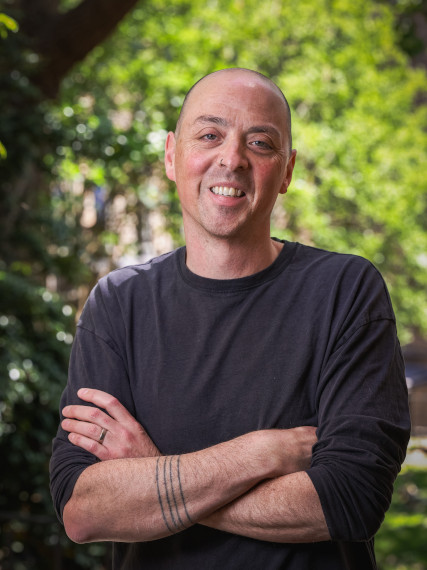
BIO
Van Dooren is Professor of Environmental Humanities in the School of Humanities and the Sydney Environment Institute at the University of Sydney (Australia) and, since 2024, a Humboldt Research Award funded Fellow in the Multidisciplinary Environmental Studies in the Humanities (MESH) research hub at the University of Cologne (Germany). Holder of a PhD from the Australian National University, from 2011 to 2017 he helped found and then worked with the Environmental Humanities group at the University of New South Wales, home to Australia’s (and one of the world’s) first undergraduate degrees in this new multidisciplinary field, before moving to the University of Sydney in 2018.
CONTRIBUTION
For two decades now, Professor Van Dooren has explored the diverse social contexts in which the global extinction crisis is unfolding, analyzing the value and the multiple meanings that endangered species hold for different cultures, and how the loss of an animal or plant can alterthe ways of life of the human communities that share its space.
The awardee defines his methodology as a kind of “field philosophy,”whose mission is to analyze in real-world settings not just the ecological costs but also the social, economic, political and cultural impacts of each extinction process, in order to articulate the most appropriate ethical response and devise the best conservation strategy.
The jury made particular reference to two of his publications, both among the most cited works of the past ten years in the environmental humanities field: his first book, Flight Ways: Life and Loss at the Edge of Extinction (Columbia University Press, 2014), exploring the multiple impacts caused by the disappearance of critically endangered birds in NorthAmerica,Australia and India; and his latest title, A World in a Shell: Snail Stories for a Time of Extinctions (MIT Press, 2022), recounting the efforts being made in Hawai’i to save snail species from the brink of extinction.
His lead role in shaping the environmental humanities is evidenced by his involvement in the 2012 launch of Environmental Humanities (Duke University Press), the first international scholarly journal given over to research in this emerging multidisciplinary field, which he also co-edited up to 2020.
In the context of today’s global biodiversity crisis,Van Dooren defines his work as a philosophical project that seeks to articulate an ethical response commensurate with the challenge: “We are living in the midst of what many experts now call a mass extinction event, and I think that that process of humaninduced extinction places us under particular kinds of moral obligations.So a lot of my work has been trying to make sense of what those obligations are, not just to stop species from going extinct wherever possible, but also to protect the wellbeing of individual plants and animals, and that of the human communities who live alongside them.
The awardee’s favored approach is to deploy his “field philosophy” to study on the ground the whole web of biological, ecological, historical, social, political, economic and cultural entanglements involved in every extinction process. For, as he says, “we cannot reach solid conclusions or propose effective solutions to address the biodiversity crisis without an empirical methodology that allows us to look in depth at all the complex factors at work in each case.”
This multidisciplinary approach is essential, he argues,to avoid mistakes and failures in the implementation of conservation strategies: “We need to consider the complexity of human social, economic and cultural structures with the same degree of attention that we pay to climate systems, geological systems or hydrological systems. Otherwise the solutions we propose to conserve biodiversity will very likely fail, because they will not gain traction with local communities, and may even worsen the inequalities and social divisions that are frequently the causes of the problem.”