

International experts meet at the BBVA Foundation to discuss science’s role in addressing the risk of coral reef collapse
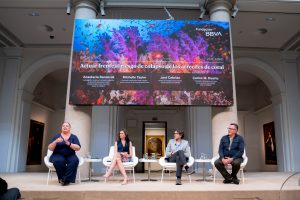
Coral reefs are under severe threat from ocean warming. Between 1970 and 2020, approximately half of all these marine ecosystems disappeared, and experts predict that between 70% and 90% of coral populations will be lost if global warming reaches 1.5°C above pre-industrial temperature levels, rising to 99% if they increase by 2°C. To analyze this alarming situation and propose possible responses grounded on the best scientific evidence, the BBVA Foundation is hosting a meeting of the G20 Coral Research & Development Accelerator Platform (CORDAP), a scientific organization that brings together researchers from more than 60 countries to collaborate on solutions for this environmental challenge. As part of this gathering of experts, the event Acting on the Risk of Coral Reef Collapse took place on June 2 in the Foundation’s headquarters in Madrid, with the aim of raising public awareness of the situation facing these marine ecosystems and of potential strategies to halt their decline.
1 June, 2026
“The world’s coral reefs are on the front lines of the climate emergency,” says the coordinator of the event, Carlos Duarte, Ibn Sina Distinguished Professor of Marine Science at the King Abdullah University of Science and Technology (KAUST) in Saudi Arabia and CEO of CORDAP. “This isn’t just about preserving a beautiful underwater world. These ecosystems support one-third of all marine species and provide essential coastal protection, fisheries resources and biotechnological assets. As a result, coral reefs generate hundreds of billions of dollars annually and support the livelihoods of hundreds of millions of people.”
If coral degradation is not halted, Duarte – recipient of the 2020 Frontiers of Knowledge Award in Ecology and Conservation Biology – warns that their loss will trigger a domino effect: “from the collapse of fisheries and increased coastal erosion to threatening the very existence of low-lying island nations, which will be deprived of the protection that reefs have provided for millennia.”
However, there is still time to avoid this scenario, and the aim of the event organized by the BBVA Foundation was precisely to convey the message that science and technology can provide the tools needed to increase coral resilience, predict degradation, and scale up restoration efforts.
Achievements and remaining challenges in the face of a global threat
Firstly, Dr. Anastazia Banaszak, Senior Researcher at the Reef Systems Academic Unit of the Institute of Marine Sciences and Limnology of the National Autonomous University of Mexico (UNAM) and Chair of CORDAP’s Scientific Advisory Committee, presented the progress achieved to date in conserving Caribbean coral reefs, as well as the challenges that remain in preventing their disappearance.
Next, Professor Michelle Taylor, Senior Lecturer at the University of Essex and Scientific Director of Ocean Census – an international initiative dedicated to discovering new marine species – shared her perspective on how to accelerate scientific research and implement measures to conserve deep-sea coral habitats.
Just Cebrian, a marine ecologist and Special Advisor to CORDAP at KAUST, outlined the latest advances achieved by this international scientific organization in coral conservation and discuss new proposals to strengthen coral protection in the future.
Finally, Carlos Duarte closed the event with a talk highlighting the importance of preventing the collapse of coral ecosystems, a goal he describes as “a generational responsibility.”
“Even with the best science and technology, preventing the loss of coral reefs will require a global collaborative effort,” Duarte stresses. “We have the capability, but we need the coordination, financing and political will. Gathering these elements is not impossible – we have seen the world mobilize and cooperate at this scale before to address the COVID-19 pandemic.”