

The impact of seabirds on coastal ecosystems
Xose Luis Otero, a tenured professor in the Applied Technology Lab at the University of Santiago de Compostela, applied for a Leonardo Grant to study the influence of seabird colonies – specifically of yellow-footed gulls – in the Islas Atlánticas national park (Galicia). His results, globally applicable, evidence the important ecosystem influence of the nitrogen and phosphorous that these birds carry. His study has just been published in Nature Communications.
24 January, 2018
In the time spent working in Islas Atlánticas, Otero and his team were able to determine that the plant communities of the park’s cliffs were different from cliff communities elsewhere in Galicia due to the perturbation caused by colonies of yellow-footed gulls. These birds act as a major channel for the transfer of phosphorous and nitrogen from ocean waters. “We were able to show that far from being a harmful presence, as was once thought, these colonies were a valuable resource.” The problem is that the yellow-footed gull is colonizing new spaces including the dunal areas of the Cíes Islands, home to singular species of considerable ecological value like the flowering plants Corema album or Armeria pungens, and habitats like the “grey dunes” assigned priority protection status by the European Union. Their conservation is under threat from the seagull colony established there some 15 years ago, which has brought with it new ruderal species with pernicious effects on the native duneland plants,” the scientist explains.
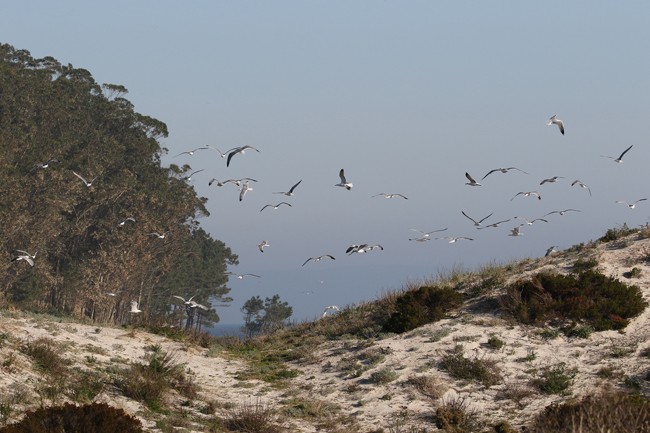
The greatest transformative impact of seabird colonies on these coastal ecosystems is the deposition of large quantities of nitrogen and phosphorous, primarily in excrement, altering the composition of soil, water and vegetation. By Otero’s reckoning, around 591,000 tons of nitrogen and 99,000 of phosphorous are excreted annually in the birds’ breeding colonies, an amount comparable to the fluxes from all the world’s rivers. The results of this project add significantly to our knowledge of the cycles of nitrogen and phosphorous, elements that play a crucial role in marine productivity.
Regarding the risks entailed by seagulls settling on the “grey dunes,” Otero is more and more convinced that the solution is to expel them. “We could establish roped-off plots to stop them approaching, or organize some kind of perturbation, like hawk flyovers, in order to drive them off at the start of the breeding season. These are both viable and cheap strategies. Remember that the “grey dunes” are virgin areas with highly specific vegetation.”
“It was the Leonardo Grant that allowed us to carry out this project,” Otero remarks. “For me, it has been a tremendous support, enabling me to keep on the technician I had and to purchase new equipment. Research, we must remember, provides jobs and training and stimulates the economy, bringing multiple benefits.”